
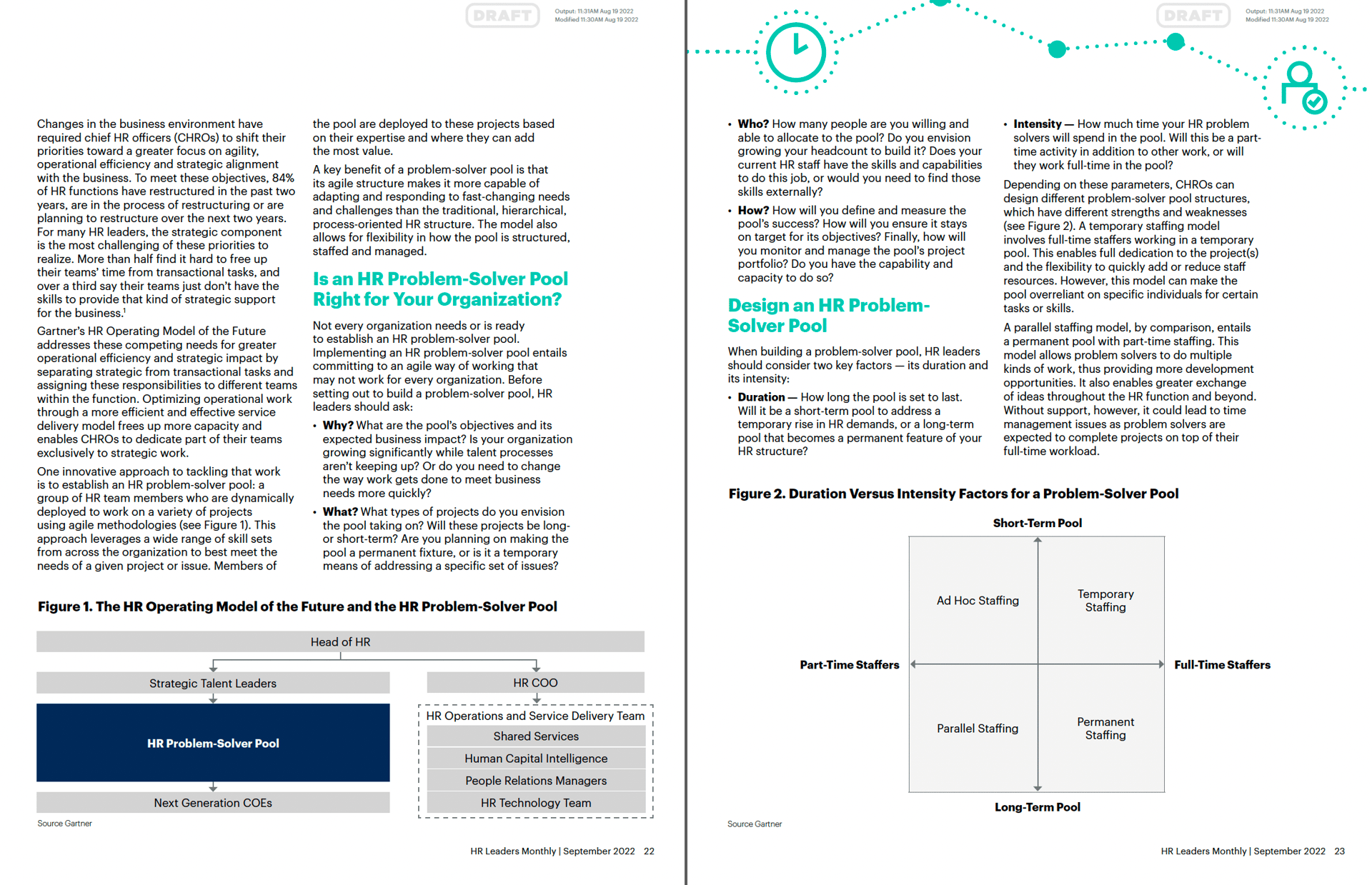
1.2 Standardised hierarchy for headings, summaries, data, and callouts
1.3 Designed for progressive disclosure: skim → scan → deep read

Journal Remixeroo
Re-architecting a research content system
The Situation
Gartner's flagship long-form research product delivered high-value insights but had become increasingly difficult to scale and consume.

High-value insights were often buried in dense formats, lacking clear prioritisation and narrative framing. The product was trusted, but its experience limited its effectiveness as a decision-support tool.
Research & Discovery
Research included stakeholder interviews, performance analysis, and competitive benchmarking, validated against organisational principles and accessibility standards.
A collaborative workshop with writers, designers, and editors surfaced workflow friction, content challenges, and opportunities for structural improvement. Insights were synthesised to prioritise problems and identify systemic patterns.
Key Insights
My Role
I joined the project as a design consultant responsible for visual direction, brand governance, and design quality. As discovery progressed, it became clear that the core issues were structural rather than visual.
I proposed shifting from a report-by-report redesign to a system-level approach, focusing on content architecture, workflow, and scalable design patterns.
From that point forward, I led the exploration of information structure, modular design, and production frameworks, guiding the team toward a repeatable, flexible systems that balanced usability, brand consistency, and creative freedom.
Make complex research easier to consume, faster to produce, and consistent at scale — without losing depth, flexibility, or brand integrity.
Strategy & Principles
Information hierarchy over decoration
Enable assets reuse, remixing, and scale
Clear guardrails with room for judgment
As a baseline not an afterthought
System Design
Business & Product Impact
Organisational Impact
